Feed QC: when is portable NIR enough, and when do you need the lab?
Can a handheld NIR cover feed intake checks? Evaluate portable and bench instruments alongside reference lab capacity using local samples and decision limits.
On this page
A maize truck arrives and the intake operator needs a moisture result to choose an unloading bay. If NIR has been validated for local maize and the mill’s procedure allows it, that decision can be made at intake. For lot release, check which method is required and when the lab should confirm a reading.
Why might NIR be the busiest instrument in a feed mill?
In its 2024 sustainability report, Japfa describes using NIR across its Indonesian feed mills to assess the nutritional quality of incoming raw materials. Its team adjusts the calibrations to its own quality requirements. That is one documented use of NIR at intake. [1]
NIR is a secondary method because it predicts composition from spectra using calibrations built against reference results. The instrument can still handle most of a shift’s routine samples. A single scan can return several calibrated parameters. At higher volumes, more eligible samples share the fixed costs of the instrument and its calibrations. [2] [3]
For example, 100 samples scanned for three parameters yield 300 predictions. Several samples may come from the same lot. Count the samples, the reference determinations you can actually avoid, and the lots on which you can make a decision separately.
When can a handheld or modular NIR handle a benchtop job?
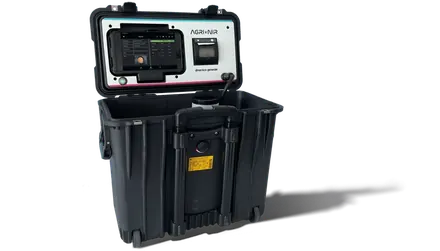
A handheld X-NIR suits an operator moving between grain intake and storage or checking forage on site. AgriNIR 4.0 measures samples in a portable case. Its EvoNIR sensor can also move to compatible machinery with the appropriate mounting kit. Check the calibration for the material, sample form and parameter you need. [4] [5]
The Goldilocks principle here means buying the capability the decision requires. In a study of two dried, ground forage grasses, a FOSS benchtop instrument gave the lowest prediction errors. The two handheld devices also performed close to the bench model. Neither handheld was a Dinamica Generale instrument. [6]
Run your own comparison with samples from different suppliers and across the working range, including samples near the acceptance limit. Use samples independent of the calibration set. Compare each instrument against the reference method on the same samples. Look for consistent over- or underestimation and for differences that change an accept-or-hold decision. Agree when to confirm a result, including borderline readings, material outside the calibration range or drift during periodic reference checks. Choose portable NIR if it meets your agreed limits. A bench unit earns its place if it demonstrably meets a tighter tolerance or handles a central sample queue more efficiently. [2] [3]
When is more reference lab capacity worth the investment?
Indonesia’s feed manufacturing rules in Permentan 34/2025 require feed quality and safety results against Indonesian National Standards (SNI) or minimum technical requirements (PTM). [7] For lot release, check the method accepted for the product and parameter under applicable requirements, the customer contract and the mill’s procedure. If a reference determination is required for every lot, its cost stays in the budget. NIR may still help staff segregate material sooner. Measure whether this reduces waiting time or rework.
The intended use matters. An Indonesian broiler-feed study drew on tests using AOAC methods at three laboratories. In the US, the USDA grain inspection service accepts near-infrared transmittance for official wheat protein determinations using specified instruments and calibrations. [8] [9]
Log the confirmation samples per shift, time lots spend on hold and what happens when an instrument is down. If crude fat extractions delay release, for instance, the ANKOM XT15 can run up to 15 samples per cycle for AOCS Am 5-04 within its scope. Check method acceptance and reserve places for controls and repeats. If confirmations are infrequent, an external lab that meets your method and turnaround requirements may be sufficient. Bring the queue figures when discussing options with AE. [10]
Sources and further reading
- Japfa Ltd. Sustainability Report 2024, Precision Feeding.
- FAO. Assessing quality and safety of animal feeds. Near infrared reflectance spectroscopy for whole sample analysis.
- ISO 12099:2017. Animal feeding stuffs, cereals and milled cereal products — Guidelines for the application of near infrared spectrometry.
- Dinamica Generale. X-NIR handheld analyser.
- Dinamica Generale. EvoNIR. AgriNIR 4.0 and compatible machinery.
- Acosta, J.J., Castillo, M.S. & Hodge, G.R. (2020). Comparison of benchtop and handheld near-infrared spectroscopy devices to determine forage nutritive value. Crop Science.
- Kementerian Pertanian RI. Peraturan Menteri Pertanian Nomor 34 Tahun 2025. Lampiran, CPPB, bagian g, hlm. 1252.
- Dayat et al. (2023). Evaluasi kualitas pakan ayam ras pedaging (broiler) yang beredar terhadap penerapan Standar Nasional Indonesia.
- USDA Agricultural Marketing Service. Wheat Protein Determinations.
- ANKOM Technology. XT15 Operator’s Manual, Appendix A. Rapid Determination of Oil/Fat Utilizing High Temperature Solvent Extraction.